
Trout - Habitat, Feeding and Fauna
Trout Feeding - Temperature, Natural Fauna, Depth and Fish Location
Fishing for trout on still waters can be a daunting prospect. In streams and rivers, it's much easier to identify likely haunts. A vast expanse of surface water on a lake is not so revealing. The margins offer the most obvious possibilities, but what if the trout aren't there?
Deeper water, without knowledge of the bottom structure can be at best, pot luck. If you have an echo sounder, you can find your way, and fish, much more easily. If you don't have one, ask regulars for location tips. You can also use a short rod (check that it's allowed) and reel with just a small weight to cast and 'feel your way around'. Make notes if you're going to fish there more often.
There are a number of other factors that can help you determine the bottom structure. Steeply sloping banks can indicate steep drop-off's or deep water, whilst a gentler slope suggests a similar slope underwater. Some venues may provide maps showing depths and possible underwater structures.
Using the correct line is a must. A floating line will allow you to fish from the surface to a depth of about 70 to 80% of your leader length. If you need to fish deeper or faster than a very slow retrieve, a sinking line from slow, intermediate or faster sinking line is required. See Fly Line Profiles.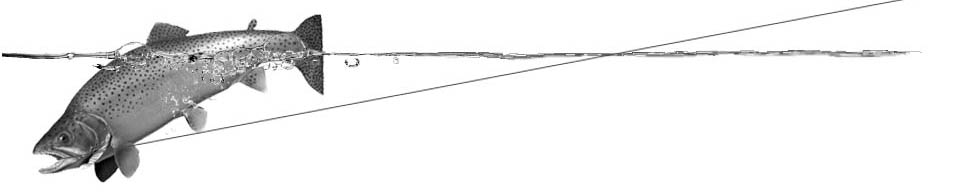
Food and Feeding.
The best water temperature for trout fishing is 50F to 60F. The fish can process their food faster and their metabolism is higher as will be their activity level, the feed-rate will be up as is your catching opportunity.
As water temperature increases, the oxygen content reduces. This also reduces the trout's comfort levels and they will move off to deeper water or they will stop feeding altogether. Therefore, it's a good idea to take a thermometer with you when fishing still-waters.
Trout will patrol the shallows, waters up to 20 feet deep. Here the habitat is perfect for both trout and their prey. Penetrating sunlight is an important factor, creating photosynthesis which stimulates plant growth and the abundant aquatic live that abounds amongst them. Amongst the myriad of creatures trout feed on are chironomidae, midges, damsels and dragon fly larvae, caddis, may flies, chorixae (water boatmen), snails, aquatic worms and leeches to name just a few of the sub-surface dwelling insects and larvae. There is just an abundant list of land-dwelling or adult insects that can find their way into the trout's food-chain.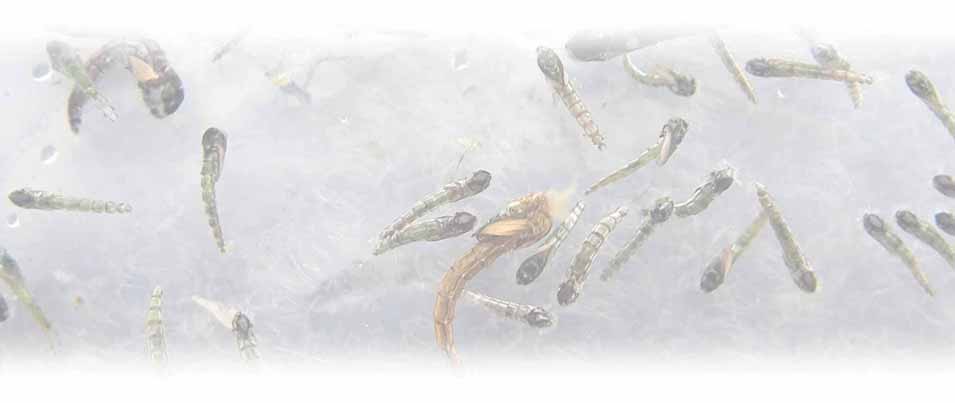
Understanding the hatches can make a huge difference to your catch-rate. As hatches slow down or stop, trout will then feed on any other food sources available. They can be very choosy about water depth depending on the temperature. In very deep waters, such as reservoirs, you can find a thermocline which is quite literally a layer of water that differs to that above and/or below it. Feeding trout can be found in a thermocline just a few feet deep in waters considerably deeper. Intense sunlight and low atmospheric pressure will drive the trout deeper. They will also seek out good foraging opportunities as they present themselves.
Where to fish is just as important, aquatic insects and fry will inhabit locations with cover: reeds, lilies, weed-beds, raised areas of the bottom, gullies, rocks, and other surface and sub-surface items that provide cover. Locate any area that may hold fauna and work your flies. There's pro's and con's to some of these. It's easy to snag up or a trout may make a run for sunken branches or weed-beds and the like, but that's all part of fishing.
Watch for any activity that gives away the location of trout. Surface takes of aquatic insects can vary in their intensity from very subtle to a trout launching itself out of the water, taking their prey on the way. Trout will only expend as much energy as is absolutely necessary. A prey item caught in the surface film will usually cause one of two types of take:
The 'Sip' rise is where a trout will come slowly up beneath a surface trapped food item and open its mouth to suck it in. This causes a tiny and momentary depression in the surface accompanied by a 'sip' noise.
The 'Head and Tail' rise often occurs where there are many food items in close proximity. A trout swims along lifting its head to take the prey, as it's head dips back, the dorsal fin and tail may just break the surface. A trout may take several such items in quick succession. Casting the right fly just ahead of a trout feeding like this will often produce.
Takes close to the surface can be detected by the resulting swirl. A quickly cast fly in the area can produce a result. I've often found that in these circumstances, a weighted nymph like a gold head, will 'plop' as it lands on the surface, quickly sinking below it. Trout are attracted by the 'plop'.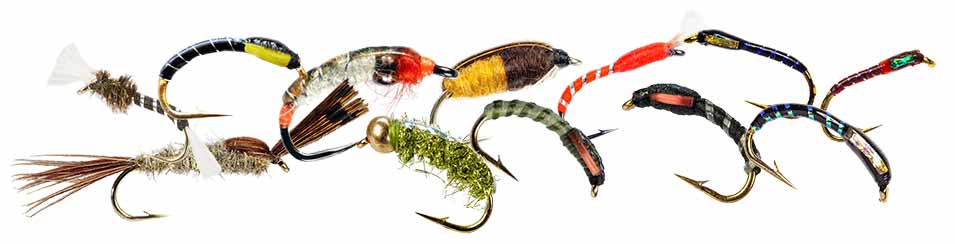
Buzzer, midge and nymph images from Flies Online
Presentation and Retrieves.
There are two main ways to animate your fly. The 'figure-of-8' retrieve and the 'strip 'retrieve':
The 'figure-of-8'... Right Handed: Holding the rod in your right and controlling the line with your right finger and thumb, pinch the line between your finger and thumb of your left hand, draw it a little whilst lifting your little finger to catch the line and draw it a similar amount. Repeating the process at different speeds can create a slowly moving action to your fly.
The 'strip 'retrieve'... Hold the rod and lines as above but this time, pinch the line between your finger and thumb of your left hand, draw it several inches. Vary this draw by just an inch or two, right up to a much longer strip of a foot and a half. Vary the speed and strip length to change the speed of retrieve. Longer pulls to imitate a small fry and shorter draws to imitate a nymph of one sort or another.
In both kinds of retrieve, the variables on offer, are speed, lengths of draw and the continuous pace. Pauses in the retrieve are also effective. The same fly fished at different depths, varying types and speed of retrieve may only produce in one combination. So it pays to experiment until you find the winning combination.
Why Can't I Catch?
The mistake that so many trout anglers make is to fish too fast and too shallow. Allow your fly to sink to the bottom and retrieve very slowly. Remember to count your fly down. Try it in the shallows where you can see it sink. Work out how many seconds are needed for your fly to reach your target depth and then be gin your retrieve. Thy the same retrieve for at least 8 or 9 casts. Then either fish shallower or faster. Slowly covering depths and speed of retrieve until you find a winning combination.
Spend some time before you fish looking for signs of feeding trout or at least their prey. Insects on the surface or trapped within it. Look out for choronomid and midge shucks (cast of skins) floating into the shoreline. If these are in good numbers, it's likely that a hatch is occurring. Match up a buzzer or hatching pupae and test the water.